What is the greatest game changer for go‑to‑market? What is most likely to drive sustainable lift to pipeline, sales and CLV? Where should we be most focused in our investments?
I’m sure if asked — given the current environment — the majority of marketing and sales leaders would cite AI. “AI will change everything!” I’m also sure that the “game changing” use cases for AI they would cite would be highly tactical — content creation, target account identification and chat automation — all time-consuming “batch tasks” where AI’s value-add is merely improving labor productivity and reducing costs.
Yet — and I’m going to say this — tactical productivity is not the greatest challenge in go‑to‑market. Period. Thus, incremental improvements will not ignite go-to-market and deliver the (assumed) panacea for growth.
So, what is the greatest challenge in go‑to‑market? It is staying engaged and relevant in the customer journey with our targeted prospects and customers.
A recent Medium post frames this challenge nicely:
Customers initiate interactions with clear goals in mind. Well-designed customer journeys help them achieve their needs with a tailored approach that considers where the customer is on their journey. Get it right, and customers will feel seen and heard in their journeys to find the things they want and need.
Get it right, and we build a long-term, valued relationship with our customer. At ANNUITAS, we refer to this as the “customer journey stewardship” challenge.
Customer Journey Stewardship: The Greatest GTM Challenge
Driving sustainable lift in our go‑to‑market programs is a function of one objective — proactive customer journey stewardship. But, as with anything, it is easier said than done.
Stewardship faces two growing challenges:
- Exponential rise in touchpoints: “Purchasing journeys contain exponentially more touchpoints than they did just a few years ago,” notes a recent BCG report. “In 2014, for example, Google research found that the average journey had nine customer-company interactions. Now companies provide anywhere from 20 to 500, depending on the offering.”
- Expansion of the stakeholder group: “The average enterprise B2B buying group consists of five to 11 stakeholders, who represent an average of five distinct business functions,” notes Gartner. “Meeting needs and driving consensus can be a challenge.”
These dynamics make proactive stewardship a challenge. There are more opportunities for distractions, and we must engage more — with more stakeholders, via more channels, more times.
Coordinating this engagement ultimately becomes an orchestration challenge.
“Modern customer journeys need to be orchestrated,” notes Medium. “Brands need to understand that engagement happens across different teams and departments. Each interaction needs to feel meaningful, or the customer is thrown off course.”
So how do we effectively drive stewardship?
To cut through, we must orchestrate — in real time — live and digital touchpoints across marketing, sales and customer success teams. We must engage as ‘‘one brand” and with ‘‘one voice” — with online and offline elements staying in sync — yet in a way that is organic to our buyer’s path. That is the core of GTM orchestration.
GTM Orchestration: The Greatest GTM Opportunity
So how do we drive GTM orchestration? To start with, it requires a mind shift — from periodic, inside-out tactics to always-on, outside-in programs.
The core rationalization for go‑to‑market must be to provide stewardship to the differential customer journeys of key stakeholders at our customer organizations. Putting the customer journey — pre- and post-sale — in the center. And scaling these interactions.
This starts with an understanding of the customer journey and key stakeholder segments, and it requires an underlying operating system to then align people, process, content, channels, technology, systems and data around this rationale.
“B2B organizations … need a methodology in place to support the creation of an audience–focused go–to–market strategy,” notes Forrester.
At ANNUITAS, our operating system to rationalize GTM orchestration is our ANNUITAS Demand Process™ methodology.
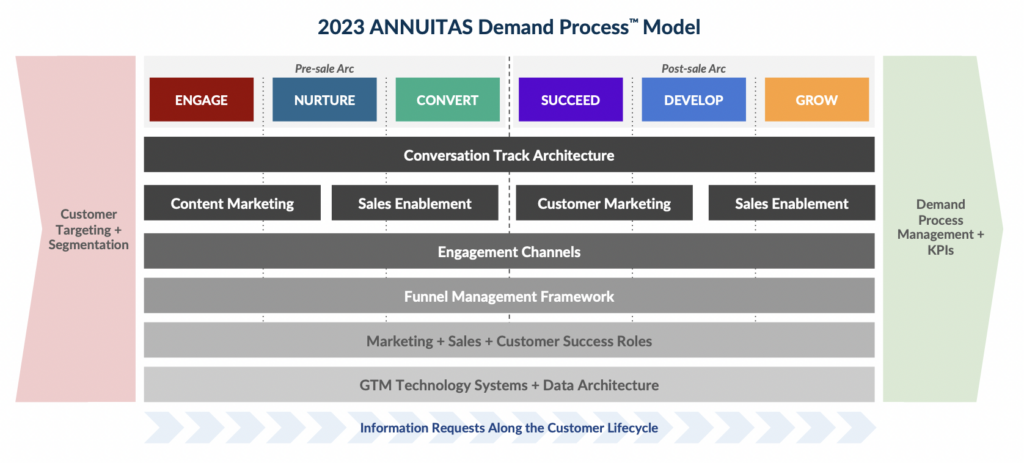
Click Image to Expand
How does this scale? Orchestration must become about “learning” where a buyer is in his/her process — through content behaviors, intent data and explicit responses. We refer to this data stream as “telemetry.” We must then have systems and data structure to process and act on this telemetry — anticipating and engaging customers via the right content, at the right time via the right channel.
An optimized, transformed and orchestrated go‑to‑market program no longer resembles a series of tactical marketing and sales ‘campaigns.’ Instead, it becomes what we refer to at ANNUITAS as a Perpetual Growth Engine.
Perpetual Growth Engine: The ‘Engine’ for GTM Orchestration
A Perpetual Growth Engine is a fully orchestrated set of go‑to‑market touch points, built on an end-to-end customer journey foundation and optimized around the critical paths customers follow through content and channel interactions. It is a perpetual program, not a campaign.
“Instead of go‑to‑market constructs centered around distribution, the new era of customer engagement will center on touchpoints—the … physical-digital-and-virtual interactions that customers have with companies as they navigate their purchasing journeys,” notes BCG.
Key elements of a Perpetual Growth Engine model include:
- Conversation Track Architecture
- Information requests model, aligned to Content Marketing and Sales Enablement matrices
- Multi-touch, multi-channel engagement, online and offline
- Two-way interfaces, such as Perpetual Profiling (vs. classic forms strategies)
- Telemetry model
- Perpetual, always-on logic and system
Prioritizing the Investment in Orchestration
We have to break the cycle of random acts — investing our GTM time and resources in a more sustainable model. That means no longer chasing random productivity gains and instead putting the customer journey at the center of an orchestrated go‑to‑market program, underpinned by Demand Process and an aligned GTM Technology Stack.
GTM falls apart in execution; thus, we need to improve — and invest in — our model for GTM execution.
Two final notes:
- Economics: For a deeper dive on the economics of orchestration and of building a Perpetual Growth Engine — I wrote a recent insight piece that digs into “The Real Cost of a Short-term Go‑to‑market Mindset.” In the piece, I look at why repeated tactical, interruptive random acts lead to a low-to-negative ROI for go‑to‑market; whereas, investing in a Perpetual Growth Engine model — building a scalable process for orchestration — delivers substantial, sustainable lift to growth.
- AI: I want to come back to AI. AI will “absolutely” be a game-changing element of GTM orchestration moving forward. In fact, the greatest, most-uber-personalized GTM interactions will be powered by AI. “Using generative AI (GenAI) to extract meaning and context across a richer set of data sources will lead to a more holistic understanding of customer intent and journeys,” notes Forrester. But we must shift how we think about AI’s value in GTM, which I covered in another recent insight piece, “Approaching AI + GTM Through a Strategic Lens — Powering Your Perpetual Growth Engine vs. Applying AI to Perpetuate “Random Acts.”