
Agentic demand technology platforms are maturing by leaps and bounds.
- Qualified — just acquired by Salesforce as of April — has delivered a strong vision for, and is rapidly rolling out, a true, multi-channel, multi-agent Agentic Marketing Platform.
- 1Mind — which recently raised $30M in Series A funding this past November — is increasingly deploying its platform across the full customer lifecycle – both on the pre-sale and post-sale sides.
Both platforms — at this stage — are capable of quite a bit more than mere on-site ‘agentic SDR motions’ (although this was the starting use case for both companies and remains the predominant use case for many of their customers).
And both platforms provide validation that robust, agentic demand technology platforms — capable of forming the foundation for a scalable, multi-channel demand engine — are now in the marketplace.
Yet most companies’ use of this technology remains nascent — with many marketing organizations engaging in endless, ‘random acts of AI’ and over-using generative technologies for content/creative production.
Few organizations have yet to seize on the real potential — i.e., leveraging AI agentic technology to underpin a robust, multi-channel, multi-agent, multi-stage Agentic / Perpetual Demand Generation Engine.
Enter the need for a guidepost. This is why ANNUITAS developed its Agentic Demand Maturity Model (see below). This model lays out an objective, target end state for Agentic Demand Maturity AND it sets meaningful, incremental maturity levels — i.e., coherent phases of development — which help marketing organizations advance the state of their agentic demand programs and processes, step-by-step towards this target. Crawl, walk, run.
Why is Agentic Demand Maturity important?
The exercise to leverage this technology more strategically is not an academic one. It matters because it represents a growth investment that can meaningfully impact top and bottom line.
Organizations that get to a mature level of agentic demand typically achieve ‘significant’ pipeline lift:
- Level 1 maturity: 25-50%+ lift to pipeline
- Level 2 maturity: 2-4x+ lift to pipeline
- Level 3 maturity: 4-10x+ lift to pipeline
As an example, one ANNUITAS client — which is currently somewhere between Level 2a and Level 2b Agentic Demand Maturity — overachieved its pipeline creation goals by 227% in 2025. Marketing is now the core growth engine for that client, contributing 57% of qualified pipeline.
What Does Agentic Demand Maturity look like?
What is our strategic objective as we apply agentic AI technology to the demand generation use case?
The critical objectives include:
- Better educating and conditioning a prospect ‘upstream’ of sales interaction — i.e., answering questions, providing content links and better framing how a prospect is thinking about a buying-stage question; providing stewardship as buyers go through the more than 3/4 of their buying journey that occurs before they engage with a live human
- Better qualifying a prospect before engaging a human — i.e., “progressively profiling” that prospect, but through a conversational interface that enables organic dialogue; ensuring the combination of right stakeholder, right organization AND right time exists before we escalate sales resources to engage
- Improving conversion of upstream dialogue into real, downstream sales “Connects” — i.e., achieving more booked meetings and live chats vs. simply marking a “Lead” that someone needs to then follow up on
- Better connecting with prospects right place, right time, right channel — which fundamentally is a core benefit of an always-on, multi-channel AND agentic system
- Better orchestrating engagement with multiple stakeholders across strategic accounts — not treating individual stakeholders as separate workflows; building relationships at target accounts bottoms-up
Fully seizing on these objectives requires us to build a multi-channel, multi-agent, multi-stage Agentic / Perpetual Demand Generation Engine — which is Level 3 maturity in the model below.
There are two elements of this outcome — strategic process and strategic platform. The assumption herein is that an organization is leveraging a mature agentic demand technology platform. The secret sauce then becomes the strategic process, which enables the path to maturity.
So what Is the path to maturity?
How do you achieve a more mature Agentic Demand state? You don’t go from zero to 60 MPH overnight. There ‘is’ some element of crawl, walk, run.
Thus, ANNUITAS has built its Agentic Demand Maturity Model to both benchmark an organization’s current state — diagnosing what it is and isn’t doing — as well as to guide marketing organizations’ forward progression.
The model has three major stages of development, and it breaks down key increments on the way to Level 1 and Level 2 full maturity.
This helps design programs that seize on the agentic demand opportunity at each level, but also serve as building blocks to increasingly higher levels of performance.
See below for the current version of the ANNUITAS Agentic Demand Maturity Model™.
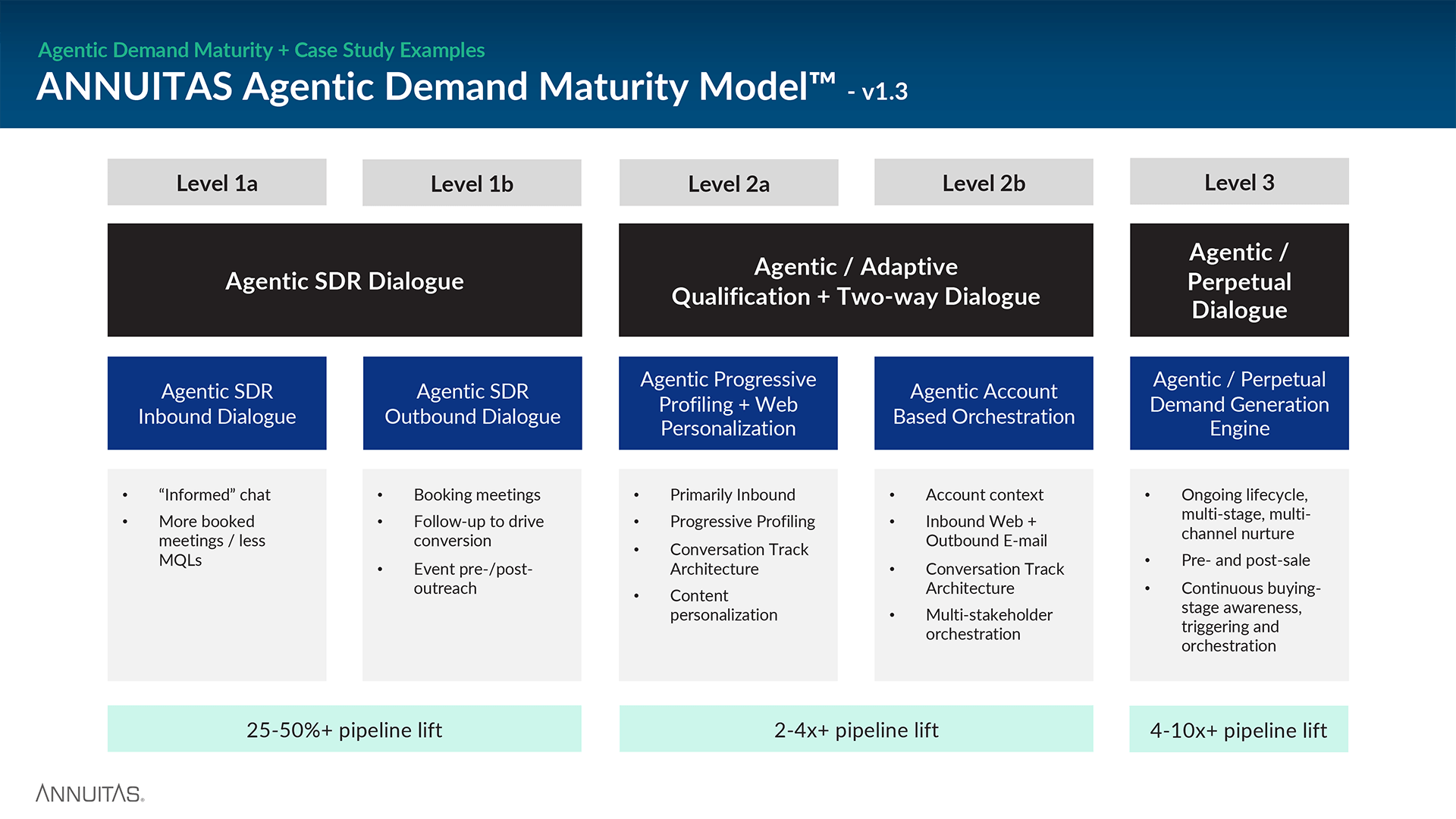
By leveraging this model, marketing organizations can ensure they are taking intentional steps forward — avoiding the pitfalls of the low-impact, but time-consuming “random acts” of AI that so many organizations are getting caught up in today.
The final benefit is that it helps guide to an actual solution – to a high-impact, sustainable outcome — vs. just ‘implementing AI agentic technology’. Far too many organizations are deploying AI technology as ‘the’ solution today and seeing minimal uptick in performance. That is because the technology, by itself, is not a solution. Successfully deploying agentic demand technology requires a clear blueprint and a ‘processes and systems’ mindset to guide the outcome. And leading with a blueprint and end vision ensures that the system of agents you are building will be governable and optimizable longer term as a coherent engine — not merely creating endless, future tech debt that ultimately will cost organizations more than they see in return.