
To help businesses align on, and achieve, their growth targets a shared system of growth-oriented KPIs is needed. Discover the suite of ‘best-in-class’ KPIs for demand marketing execution below.
Most marketing, sales, customer success and finance teams believe they are more than capable of managing the workflow and performance of their individual departments, and this is probably true. Yet these teams typically struggle when it comes to shared, inter-departmental KPIs – especially those that relate their federated demand marketing interactions through a closed-loop lens.
There is no doubt that breaking down marketing silos has significant benefits. “Research by BCG and Facebook in 2019 found that strong CMO-CFO relationships can unlock financial improvements of 20% to 40%,” according to BCG. Yet we are rarely able to get to this level of alignment.
Our challenges with GTM KPIs fall into two major categories:
- Successful, modern demand marketing execution is inherently interdisciplinary – i.e., orchestrating marketing, sales and customer success teams around a customer lifecycle in an effort to optimize customer lifetime value (CLV). Thus, demand marketing KPIs must represent – and enable you to optimize – this ‘orchestrated’ activity, which requires a strong, multi-touch closed-loop and mutual understanding between different teams.
- Perpetual, always-on demand looks very different than traditional “campaigning” – i.e., making the shift in your demand marketing execution from random acts of marketing and sales to building a perpetual growth engine. This shift has significant implications for the KPIs required to optimize demand programs and processes; thus, demand marketing KPIs also must govern – and enable you to optimize – a “perpetual” process vs. “one-off,”traditional campaign interactions.
Organizational barriers and a shift in the nature of demand marketing programs together present significant challenges to establishing and being successful with demand marketing KPIs – and explain why this is frequently an Achilles heel for many organizations.
Demand Marketing KPI Goals
So how do we get beyond these challenges? The starting place is to frame demand marketing KPIs via a clear sense of the “goal” of these KPIs. What is the performance you are trying to assess and respond to?
Effective demand marketing KPIs must enable companies to do three things:
- Diagnose predictive, executional demand marketing issues – Our demand marketing KPIs must help us zero in on specific friction points and bottlenecks in our demand system(s) and identify the executional Levers required to adjust and tune these dynamics. This requires moving beyond “rear view,” summary financial metrics. Too often finance and sales leaders focus on high-level outcomes but struggle to understand underlying dynamics to improve these outcomes. Thus, demand marketing KPIs must visualize the interdependencies between demand execution and demand outcomes.
- Optimize the demand marketing execution “mix’”– Our modern customers and their organizations do not make decisions in a single-threaded, single-channel manner; rather, they engage multiple stakeholders and influencers via a massively multi-channel series of interactions as they go through their buying process. Thus, our demand marketing KPIs must focus on the “mix” – the “portfolio” – of Levers, instead of any “single” Lever to optimize overall demand marketing execution. Ultimately, the goal is to identify the critical path of engagement channels, content offers and salesperson interactions that most commonly leads to growth outcomes – and then to optimize demand marketing around this critical path.
- Maximize demand marketing ROI through a closed-loop, CLV lens – The primary objective of demand marketing execution – as we orchestrate customer engagement – should be to maximize “Lift to CLV.” I.e., our combination of interactions should focus on getting the most out of each customer relationship. Too often marketing is focused on acquisition or on a volume of “one-time” sales, but optimizing the ROI of demand marketing means maximizing CLV.
A Demand Marketing KPI “System” – Vs. a Single “Magic Bullet”
The discipline of optimizing demand marketing execution – tuning key Levers to optimize Lift – points to a critical reality for demand marketing KPIs. I.e., there is no “one” KPI – no single “magic bullet” – no individual demand marketing KPI that is the singular ‘”key” to understanding and optimizing demand marketing execution. Rather, what we need is a system of KPIs that work together and help us tune the portfolio.
So what are the KPIs we need to optimize demand marketing?
ANNUITAS has developed a Demand Marketing KPI System it uses with its clients that divides demand marketing KPIs into four categories:
- Lift
- Conversion
- Velocity
- Levers
The graphic below lays out this system:
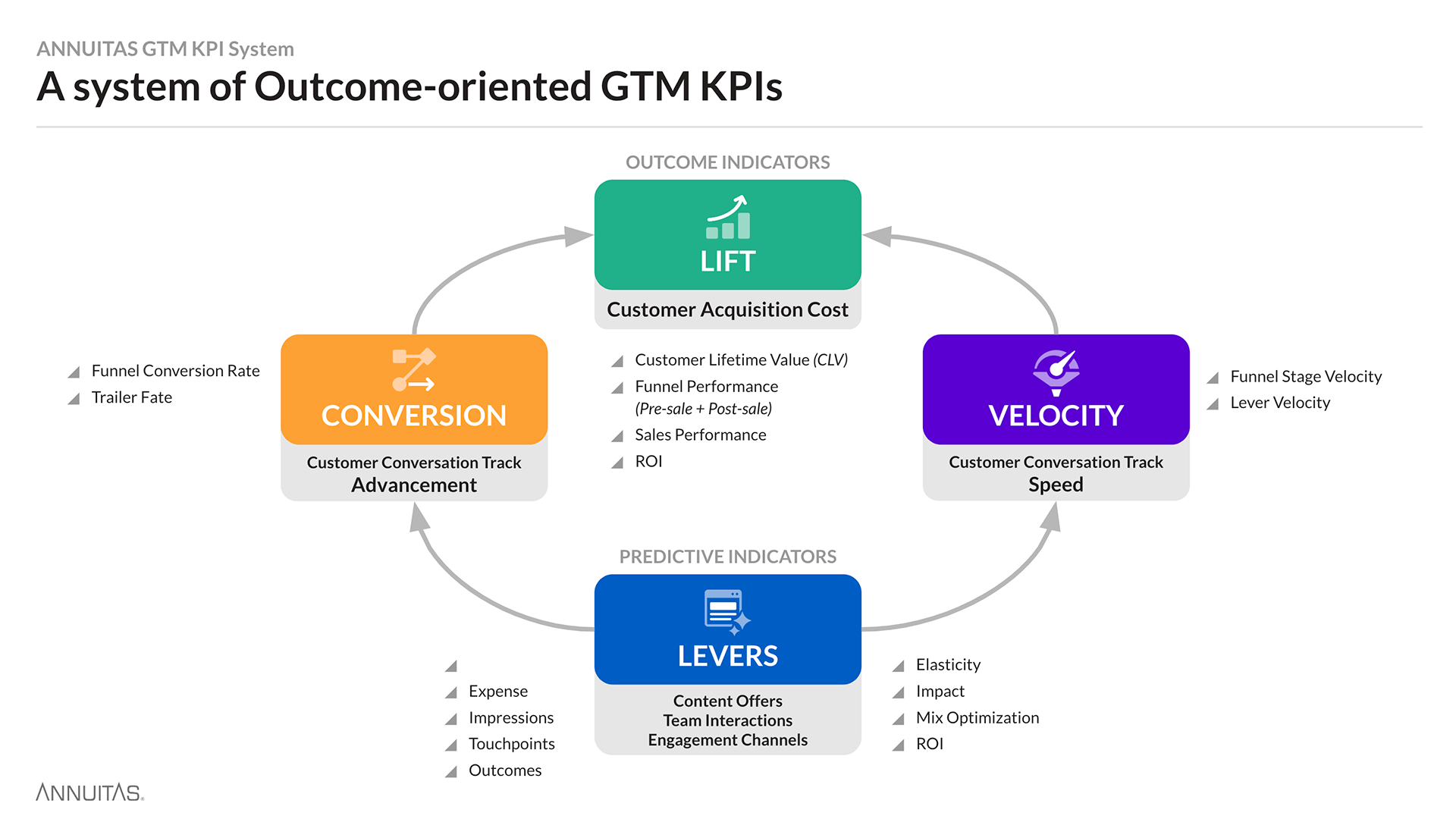
The system works end-to-end, with Levers driving Conversion and Velocity, which drives Lift.
Let’s break down the system into each layer and dig into the underlying KPIs in each category.
Note: If you scroll to the bottom of this whitepaper, you can download a PDF with the complete ANNUITAS Demand Marketing KPI System for reference as you go through each section below.
Lift KPIs
Top-line lift – or “net” growth in customers and revenue – is the ultimate goal of all demand marketing investments. The most important lift to drive is lift to CLV; however, we are also interested in driving lift in related metrics, such as net-new customers and in key investment ratios, such as CAC:CLV ratio, and of which help to contribute to CLV and profitability.
Below are detailed breakouts for our key Lift KPIs related to:
- Customer health
- Top-line results
- GTM investment ratios
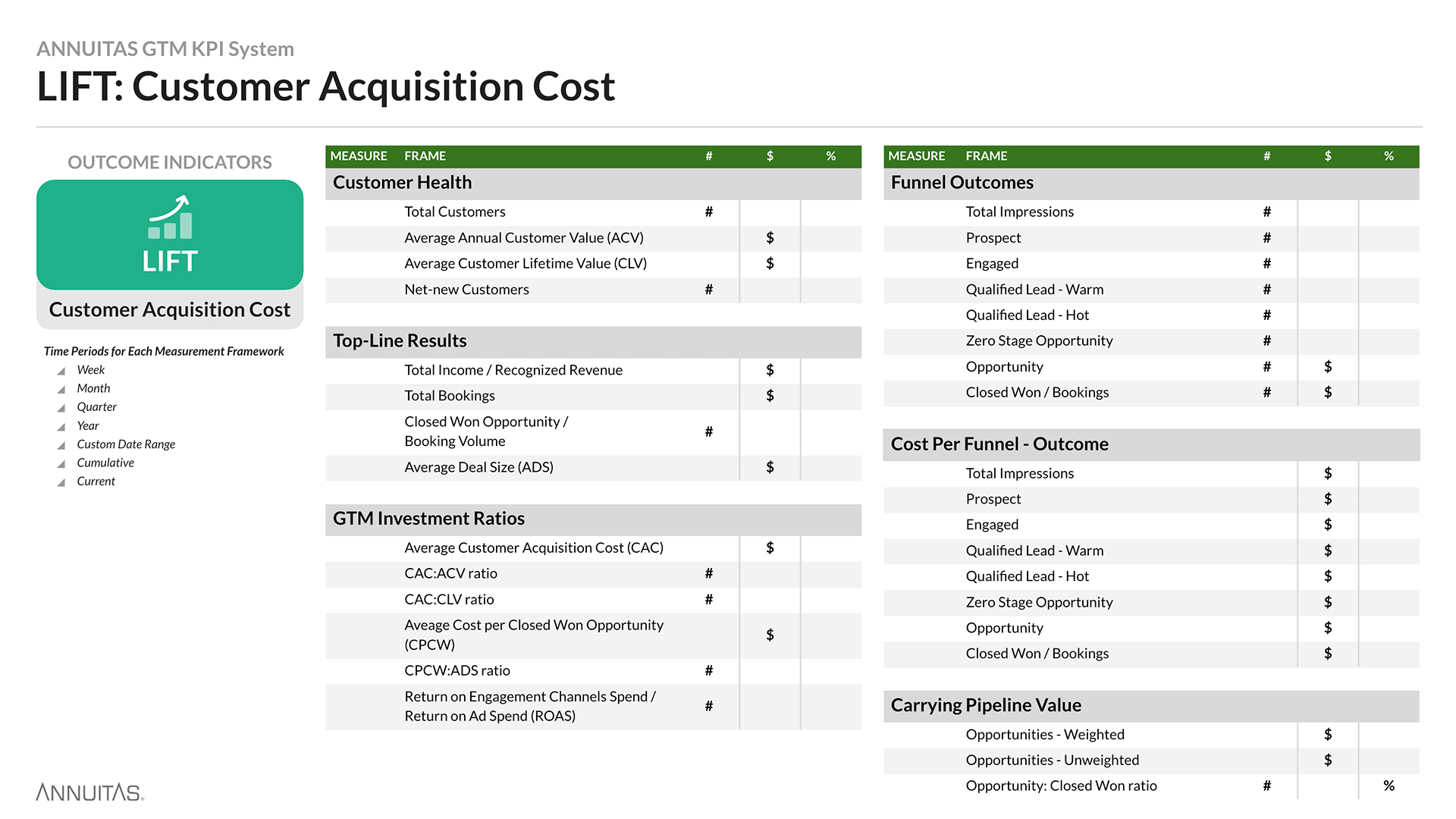
It’s also important to look for “upstream” lift – i.e., lift occurring earlier in the funnel as an indicator of down-stream impact. We also look at KPIs related to lift (or reduction in) cost per funnel outcomes and overall lift to the active pipeline.
Below are detailed breakouts for our key Lift KPIs related to:
- Funnel outcomes
- Cost per funnel outcome
- Carrying pipeline value
Conversion KPIs
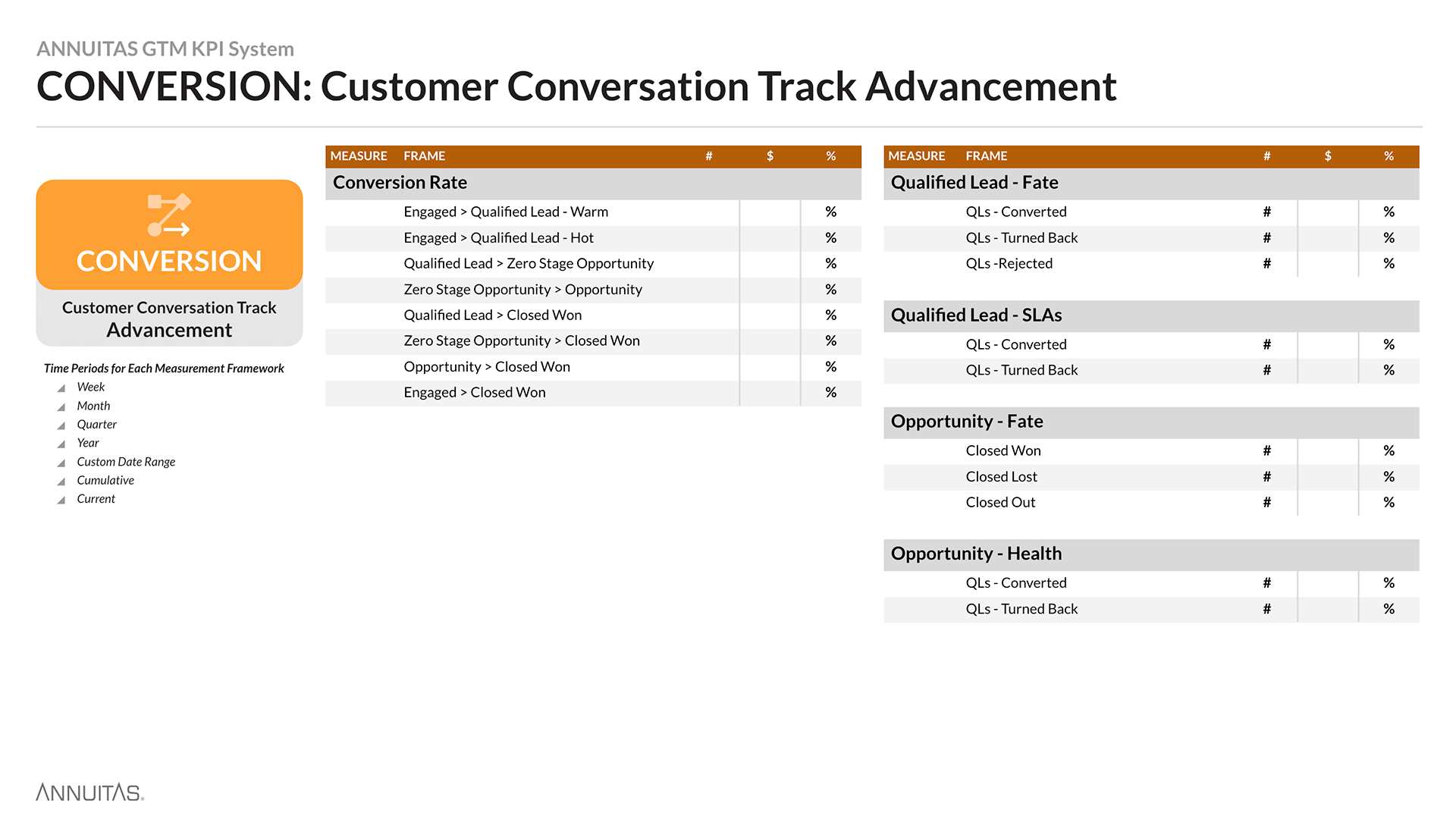
Conversion is an indicator of the overall health and efficiency of our demand marketing process through all funnel stages, pre- and post-sale. This is a critical piece of “telemetry” we must track in demand marketing programs, both end-to-end and through the lens of intermediary steps, so we can zero in on bottlenecks and improve throughput.
Below are detailed breakouts for our key Conversion KPIs related to:
- Conversion rate
- QL fate
- QL SLAs
- Opportunity fate
- Opportunity health
While we look for overall efficiency and throughput through the funnel, we also look at Conversion through the lens of ICP. For ideal customers, we want to see a combination of engagement, demographic/firmographic fit and lower funnel/intent behaviors to ensure prospects “look like” our ideal and highest CLV customers. So, while one view of Conversion is about constantly improving throughput, the other view is ensuring there is not so much throughput that what is getting through is lower quality because the prospect doesn’t fit these criteria.
Velocity KPIs
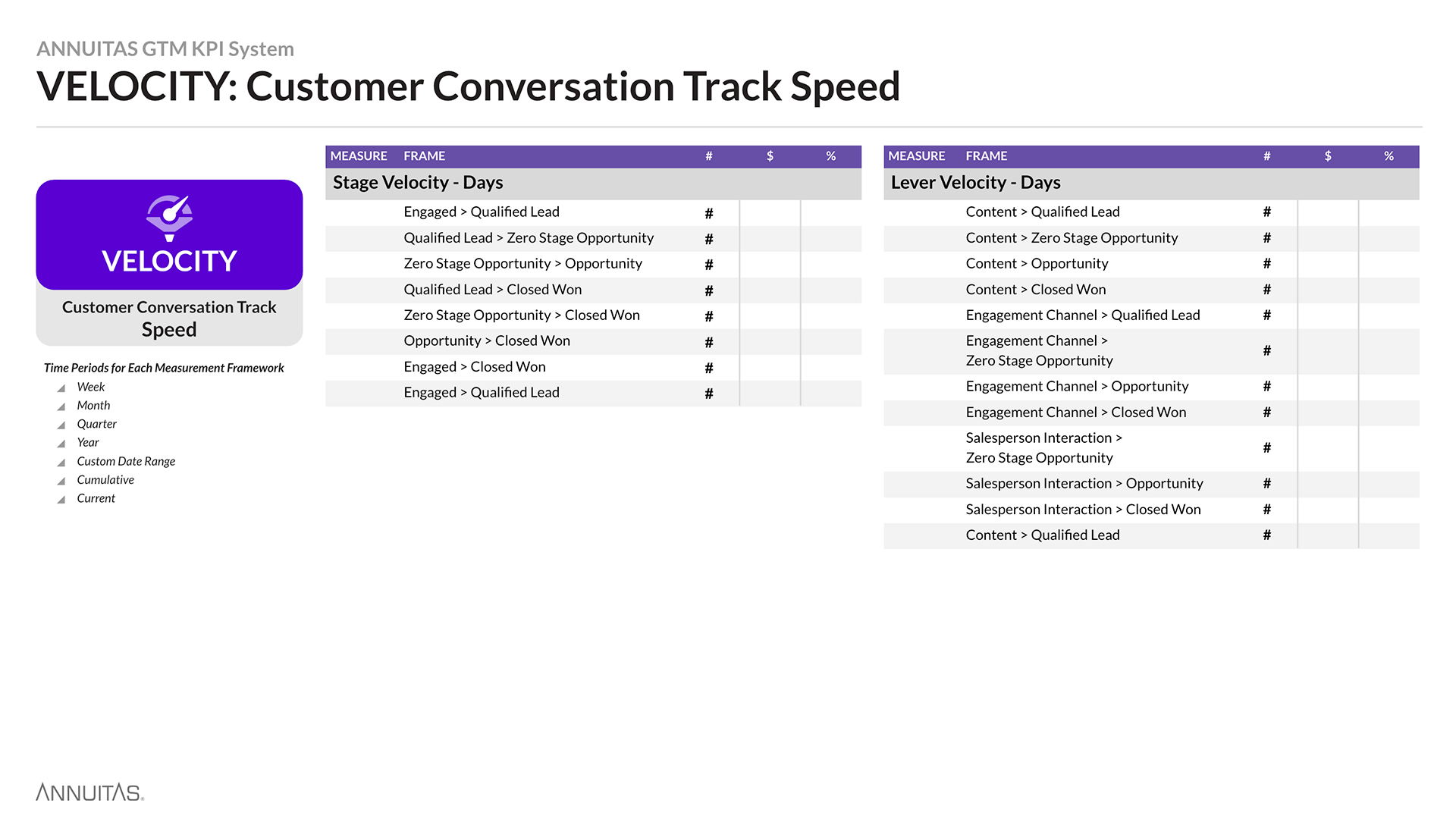
Velocity measures throughput time — i.e., the speed (or lack of it) at which a prospect moves between demand marketing states — both pre-and post-sale — and the overall time attributed to the interaction-to-spend cycle for customers. Our goal is to be able to track the velocity between interactions and outcomes and to optimize this over time.
It’s important to also know that for some customers in their buying journey, velocity cannot be infinitely improved — i.e., we cannot get them to “spend” faster than their current buying process will allow. We can reduce frictions, but there is an organic cycle time. Thus, another important perspective on Velocity is understanding how long it really takes from initial interaction through demand states to achieve commercial outcomes, making it a key input for understanding “organic” velocities in forecasting and demand planning.
Finally, one key insight into optimizing critical path – i.e., ensuring we have the right content, engagement channel and sales interactions at the right stages of the customer journey – can be derived by looking at Lever (see below) Velocities. Lever Velocity is the time between an interaction and the funnel stage outcome. By analyzing Lever Velocities – and aligning the chronology of interactions – we can break down which types of interactions are most appropriate at various stages of the customer journey.
Below are detailed breakouts for our key Velocity KPIs related to:
- Stage Velocity – Days
- Lever Velocity – Days
Lever KPIs
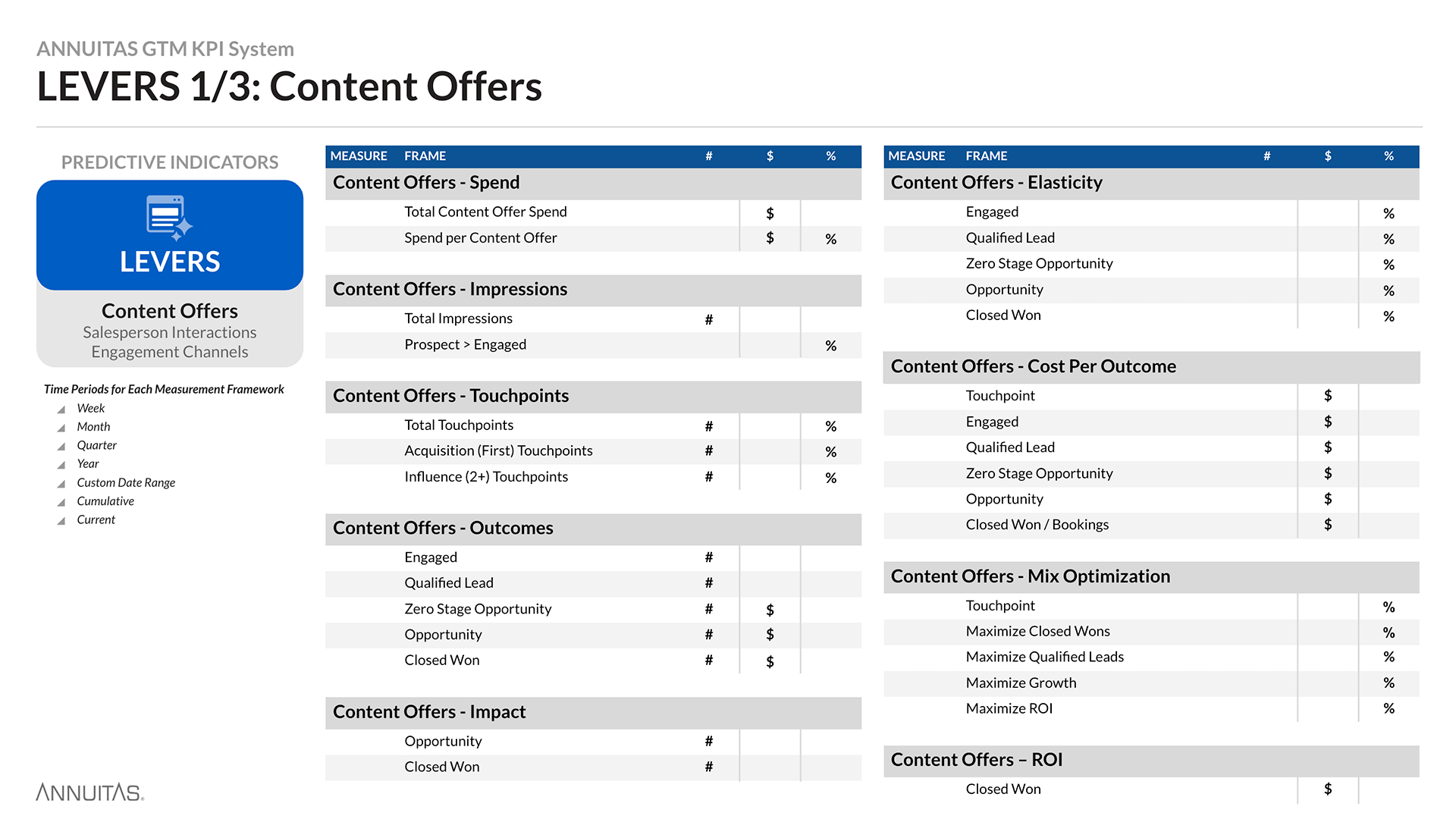
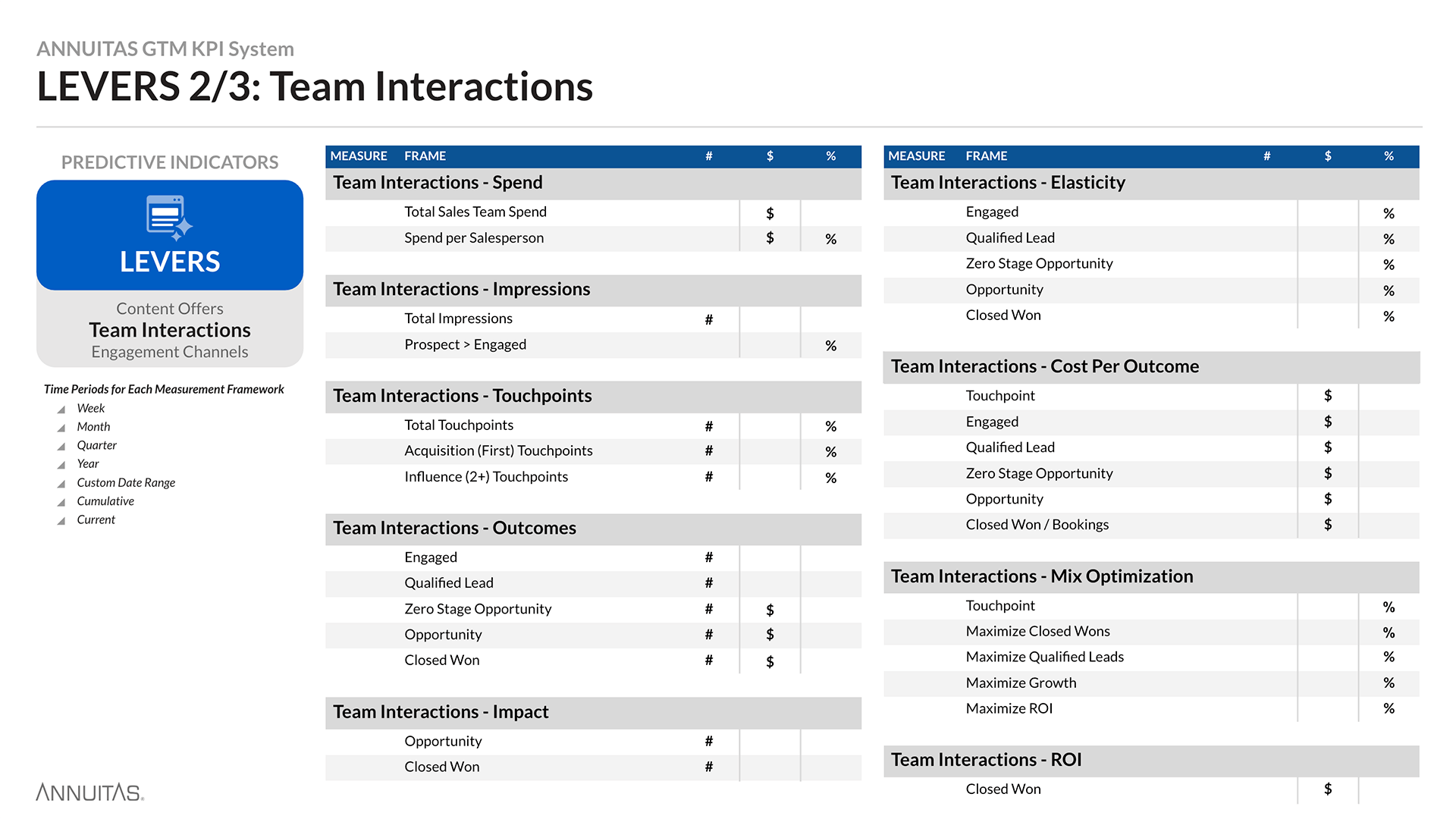
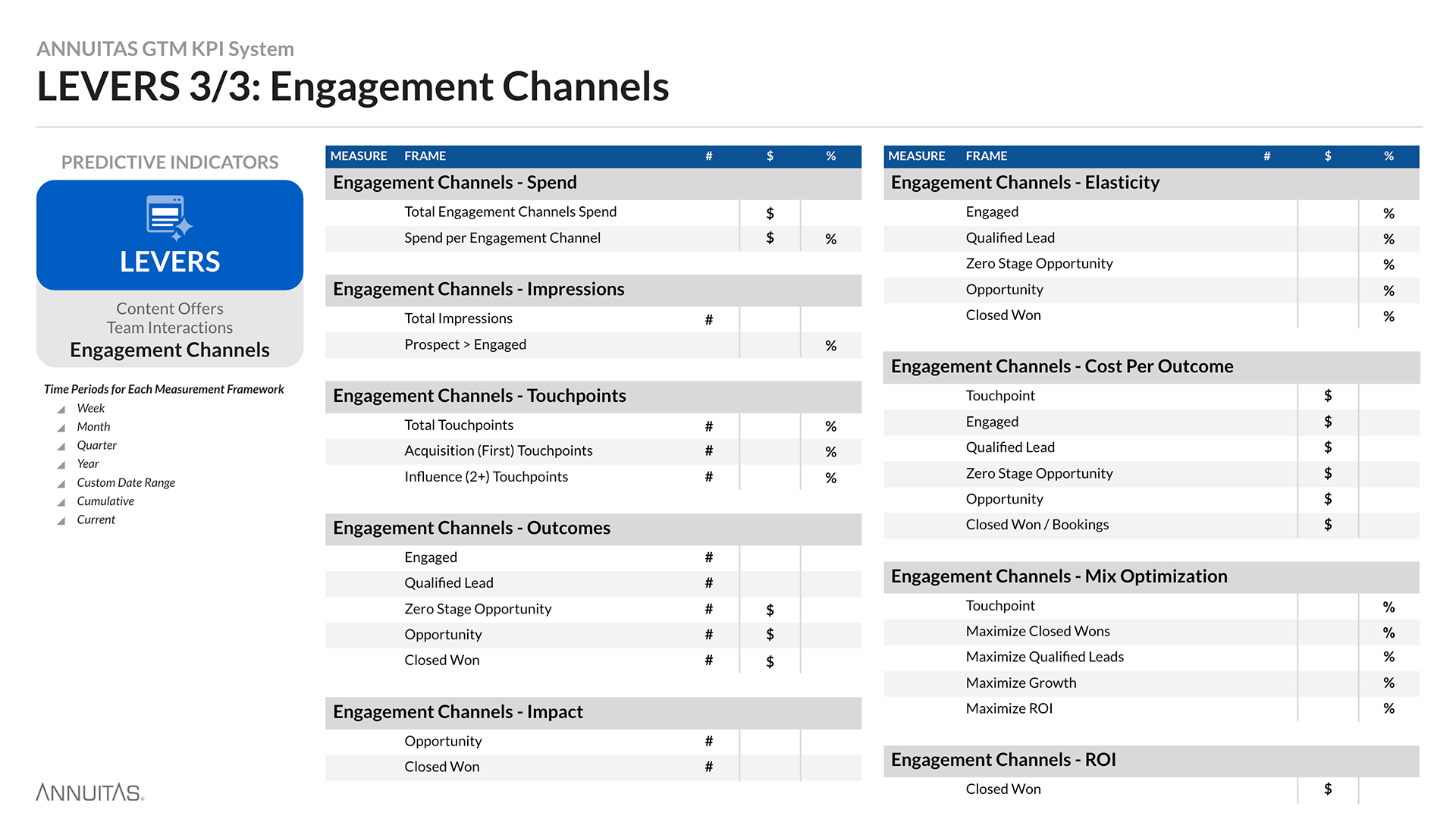
Our final KPIs – our foundational layer of the system – are Levers. Levers are our interactions with prospects and customers, assessed through their impact on funnel progression.
Our key Levers include:
- Engagement channels
- Content offers
- Salesperson interactions
Lever (interaction) data is derived from key systems including, Web CMS, marketing automation and sales cadence management platforms. The data that populates Lever KPIs is rooted in “multi-interaction tracking” (“MIT”) data.
Our KPIs enable the analysis of Levers via activity volume, how these interactions drive funnel outcomes, the elasticity (or productivity) of these interactions, and both the cost and ROI of these interactions. Ultimately, we want to be able to see the portfolio of interactions for a given customer contact, Conversation Track, or account, and be able to optimize our mix to drive the greatest Lift for the business.
One KPI of note is “Impact Expectation,” which is the product of outcome volume times elasticity. This can be a useful metric that helps rate the relative commercial impact of different Levers.
Below are detailed breakouts of each of the Lever categories:
Click here to download a PDF with the complete ANNUITAS Demand Marketing KPI System.
More from ANNUITAS on Demand Marketing KPIs
For more investigation into best-in-class KPIs from ANNUITAS, check out these past insight pieces:
Optimizing Demand Marketing Program Lift through a Converged Growth System of KPIs
The Six Demand Marketing KPIs that are Critical to Achieving Growth