
The advent of AI agentic demand technology is rapidly changing the capabilities of B2B demand generation.
For more than a decade, marketing automation technologies enabled our team at ANNUITAS to build out mature, advanced Perpetual Demand Generation Engines for our clients — driving relevant, personalized content to prospects, in an always-on fashion, across multiple inbound and outbound channels. Yet the ‘build-out’ of these engines and the ongoing maintenance of perpetual programs was still highly manual (and therefore time/labor intensive). And the ability to ‘truly’ orchestrate across channels and stakeholders was always limited. Finally, the model itself was always still interruptive and delivered via content offers and form submits. Make no mistake, first-generation perpetual demand was high ROI — achieving as much as 4-10x improvement in demand generation ROI — but I can admit that the process to get there was ‘heavy’ to build and too time-intensive to manage.
AI agentic demand technology changes this equation.
We are finally able to shift from manually-built ‘automation’ to true adaptive, semantic orchestration that is more ‘trained’ than built. (which, BTW, makes your front-end strategy and process ‘blueprinting’ more important than ever before.) This speeds the time to build out an Agentic Demand Engine. We are also able to extend the reach of our engagement orchestration — spanning a massive set of buying stages, stakeholder segments, channels and behavioral/account-based intent ‘signal’ types.
An Agentic Demand approach increases both our time to value and the ultimate ROI of our demand generation engine.
Where Does the B2B Demand Funnel Model Fit in Here?
The goal of any “Funnel Model” is to enable us to monitor and manage the results of staged marketing and sales activities as they drive prospective buyers and accounts along a so-called “lead-to-revenue process.”
There are definitely different POVs on the Funnel. Some want it to be about buyer journey; others want to extend it to be both pre- and post-sale (i.e., the Winning by Design “Bow Tie”); some want to focus on Opportunity stages only; others want it to extend as far up the buyer journey as possible; and finally, some want to ‘flip it’ entirely.
So what is the common theme? In all instances, the goal should be to help visualize the progression of prospective business flows forward — from earliest pain point to closed won (and potentially renewed, expanded) business, if you are looking at post-sale demand. An effective funnel thus is about managing an operational process — both allowing us to see current state, as well as to help dig into the stages of the funnel — and to identify key levers — to address issues and to optimize.
The B2B Demand Funnel ultimately is a mechanism for visualizing the performance of and tuning our Agentic Demand Funnel. Given a new technology environment — and a new Agentic Demand Engine model — it’s time to bring the funnel forward and update it (not abandon it) — making it relevant for its evolved mission.
Is This the End of the “Lead” and of the “MQL”?
Agentic Demand introduces a key shift when it comes to funnel stages.
Classic Funnel paradigms at some point in the process always produced a “Lead.” Arguably, the greatest challenge in ‘1.0’ demand generation engines was the Lead. Because at the end of the day, the entire success or failure of the engine — and of the entire L2R process — depended on a single person picking up that Lead and converting it to a meeting and/or open Opportunity — or not. And unfortunately, the margin was always on the side of ‘failure,’ not success. Even in the most efficient demand generation engine, Leads failed to convert more than they didn’t.
In a 2.0 demand generation engine — i.e., an Agentic Demand Engine — we are changing the paradigm entirely. We are leveraging AI agentic demand technology to drive a system of two-way flows — i.e., agentic ‘dialogue’ — which ultimately engages, educates and conditions buyers in tandem with profiling them and reading behavioral and organization intent signals in order to qualify them. This system is occurring continuously in a real-time and always-on manner, which means it can continue to engage until the buyer really is ready to escalate the dialogue and connect with a sales executive.
This means the ‘intermediary’ objective of our Demand Engine is now to enable a “Sales Hand-off” — i.e., a direct connection of a B2B buyer to a sales executive. There is no Lead. Just a live connection — via a booked meeting or by initiating a live chat/call.
How Does This Translate Into an Evolved POV on the B2B Demand Funnel?
I’ve followed closely some recent, spirited posts on this topic. Former Forrester analyst Simon Daniels is not willing to give up on the Lead and has argued for why MQLs are still relevant. Eloqua/SiriusDecisions veteran Steve Gershik (great guy), meanwhile, has declared the funnel to be dead. But what he is really saying is that “[t]he failure [of most funnels] is lead-centric thinking.”
These are smart guys. And this is not the limit of the debate.
But given my articulation above that a B2B Demand Funnel is “… a mechanism for visualizing the performance of and tuning our Agentic Demand Funnel,” I can’t see a scenario where a Funnel is un-necessary. How are you going to drive the car without basic instruments?
In fact, I’m going to argue that in the Agentic Demand era, the Funnel is more important than ever before.
One of the greatest challenges of leveraging AI agentic demand technology is the ‘black box’ that occurs when an agent works a prospect forward. What content did it send? What questions did it ask? What stage in the L2R process is that prospect and Account in? And where is all of this critical information?
We cannot operate and tune our Agentic Demand Engine in the dark. We need structured telemetry on how our Agentic Demand Engine is performing in real time. And we need a structured view of the continuous equation that leads to the greatest lift to pipeline (and Closed Won Opportunities).
We ‘need’ the B2B Demand Funnel. But we need a revised version of it.
What Factors Should a B2B Demand Funnel Consider?
Tracking and optimizing funnel progression for a 2.0 model — for Agentic Demand — requires a re-think. Starting out, some of the factors we want to see:
- Activities and interactions, inbound and outbound — all of them, multi-touch
- What a prospect’s content consumption says about his/her interests
- When there is real dialogue with our AI demand agent; what our agent said
- What types of responses our buyers are providing to profiling questions
- What type of intent signals are coming from the buyer and their company
- When that dialogue and intent shows thumbs-up that an Opportunity may exist
- When a “Sales Hand-off” happens
We also want to be able to see the math and conversion through the pipeline. So seeing the ‘total addressable’ size of our target accounts and the full number of stakeholders across these accounts (and across personas) is an important ‘top of funnel’ piece. And we want a sense of the ratios of activities to stakeholders, engaged stakeholders to accounts, etc.
All of these factors help measure the engagement and commitment of our prospective buyers and their companies. Going back to an arbitrary ‘Lead’ does none of this justice.
So What Does This New Funnel Look Like?
The revised / resultant funnel is not revolutionary, per se, but engrained in it are several new concepts:
- Driving demand efforts towards “Sales Hand-offs” vs. passing Leads. Specifically, the Agentic Demand Engine is making live connections between buyers and sales executives — either directly booking meetings on the seller’s Outlook / Google calendar OR opening up direct, live chats and conversations with available sellers. So the entire inefficiency and latency of a Lead model is eliminated. And Agentic Demand Engine remains in 100% control of orchestrated engagement with a prospect until a Sales Hand-off is made.
- Measuring levels of engagement and dialogue prior to Sales Hand-off. One goal of a funnel is to be able to see elements of it that need to be optimized. We don’t want to go from random demand interactions to a booked meeting. Thus, there are two phases that address and identify increasing levels of readiness of buyers to engage with sales executives. “Engaged Dialogues” marks the point at which inbound and outbound demand interactions turn into actual, two-way agentic dialogue and where there is clearly sustained interaction between buyer and AI agent. And “Qualified Engaged Dialogues” marks the point at which there is not only sustained, two-way engagement, but where the progressive profiling questions from the AI agent and/or the behavioral and account intent signals indicate there is growing interest and lower-funnel actions being taken. This is a strong indicator that the time has occurred for the AI agent to make a live connection to a sales executive.
- Driving a combined Account-based and Contact (Stakeholder)-based progress model. The Account vs. Lead debate should be over. Any go-forward model must target ICP Accounts AND orchestrate engagement with the key ICP Stakeholders within the buying unit. Both. At the same time. Thus the Funnel Management Model must engrained and be able to be pivoted in both directions — providing visibility into BOTH the Stakeholders and the Account.
Here is a WIP model we have been developing at ANNUITAS — and are starting to deploy with clients. We call it our ANNUITAS Agentic Demand Funnel Management Framework™.
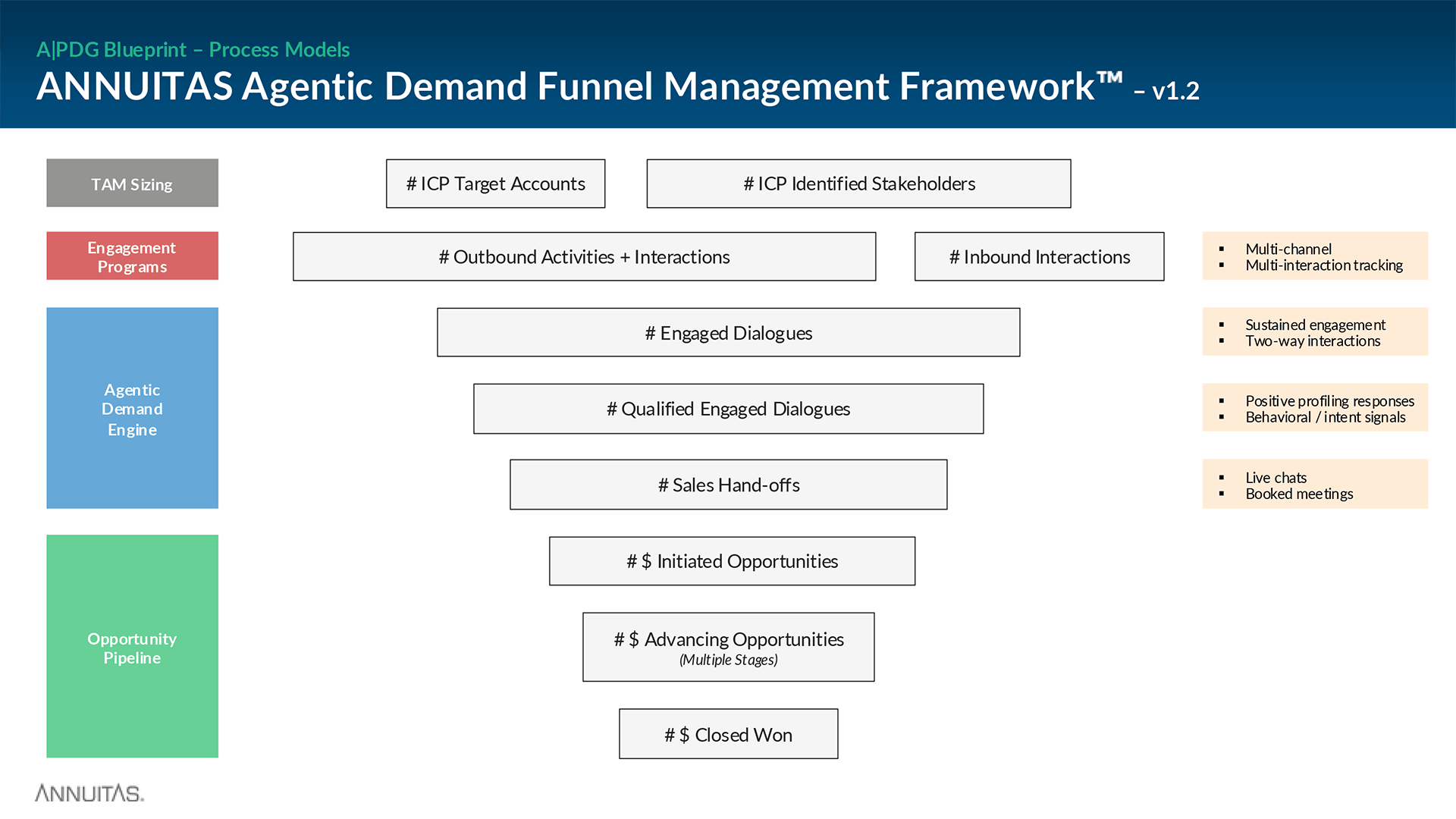
As I said, this is not revolutionary but is definitely ‘evolutionary.’ We are bringing what still works for a Funnel forward, but evolving concepts for a state where the interface between Agentic Demand and sales executive engagement in an Opportunity Pipeline is seamless.
Also — this is the high-level view, but we ultimately visualize this at a deeper level for key sub-components — with additional visualizations and a system of KPIs that support its optimization. (So just to recognize the funnel above is the top level view, but we advocate for more granularity in each area — to be able to ‘click through’ and see what needs to be optimized.)
I’d love to hear your feedback on these concepts. Ping me if you’d like to connect directly to dig in further.