
The data is clear. Demand Marketing really ‘has’ gotten a lot harder over the past decade – especially since 2019.
As B2B marketers and sellers, we are caught in a challenging (and rapidly-changing) media and technology environment, coupled with challenging macroeconomic headwinds. This combination has made engaging with targeted B2B prospects more challenging than ever before.
Examples include:
- Declining search marketing performance: The cost of search marketing has rapidly increased; meanwhile, our results have just as quickly decreased. Most recently, SearchEngineLand headlined, “Google organic and paid CTRs hit new lows.”
- Poor email engagement: Email open and click rates also have trended downwards over the past few years. In fact, “only 8% of marketers [find] email marketing to be an effective avenue for lead generation [today], with some considering it their worst-performing channel,” according to a recent Forbes article.
- Permanent marketing budget cuts: Amid these challenges, and largely in response to higher Fed rates since late 2022, CFOs have permanently slashed marketing and sales budgets – de-investing in demand and growth programs. Corporate marketing budgets have been reduced by nearly 1/3 between 2019 and 2024, according to Gartner research.
Navigating the Complex B2B Buying Process Has Become More … Complex
It’s not ‘new’ news that the B2B buyer is evolving. This has been going on since I published Balancing the Demand Equation in 2011. But marketing leaders today have severely underestimated the degree to which connecting with B2B buyers – right place, right time – has become more challenging.
This is not just an AI story or a changing engagement channel preferences story. Those things are certainly happening. But underneath it all, the fundamental nature of how B2B decisions are made is continuing to shift.
We are seeing:
- Exponential increases in the number of buyer touchpoints. B2B buyers today are engaged in massive content consumption as they move through their buying process. A recent Google Study showed the average B2B buyer journey includes anywhere from 20 to 500+ content touchpoints over the course of a complex purchase decision. In DemandGen Report’s “2016 Content Preferences Survey Report,” they noted, “47% of buyers viewed three to five pieces of content before contacting a sales rep.”
- AI-generated marketing content and sales cadences are now the new “white noise” in demand. Rather than helping us get to answers faster, AI is blanketing the B2B decision-making landscape with smoke clouds. AI is enabling automation of our worst cold-outreach marketing and sales practices, as well as causing the proliferation of demand content that largely all sounds the same. And now it’s on auto pilot.
- Buying committees are growing – the number of stakeholders involved in B2B buying processes has nearly doubled over the past decade: “The priorities of B2B buyers today are constantly in flux, and a renewed focus on maintaining profitability … brings increased scrutiny on decisions,” notes SBI. “As a result, we see buying groups getting more members, with an average of 11 stakeholders per team.” This contrasts with research from CEB in 2016 that found, “[T]he average number of customer stakeholders involved in a B2B purchasing decision is 6.8.”
- Buying cycles are getting longer – increasing 2-3x over the past five years: “The average B2B buying cycle [today] lasts 11.5 months,” according to 6sense. As more stakeholders are involved, and as there are more information requests in the buying process, the result is an elongating buying process. The other reason: overall indecision amid marketplace uncertainty, which Forrester says leads to a ‘stall’ in the buying process 89% of the time. This protracted, current buying cycle length contrasts with a Marketing Charts 2019 survey that found “that three-quarters (74.6%) of B2B sales to new customers take at least 4 months to close.”
- B2B buyers are being asked to do more with less: Despite compressed budgets, B2B buyers’ expectations around getting the most value for the money spent are becoming outsized (and unsustainable).
The result of this shift? As buying journeys become more complex – and short-sighted demand marketing and sales outreach efforts fail to hit their target – B2B buyers are simply choosing to not engage. Instead, they are “ghosting” you.
It’s time to find a new way to break through.
A New Formula for B2B Buyer Journey Engagement
Fortunately, our challenges with B2B buyers also provides insight into how to navigate – and drive engagement throughout – the modern, complex B2B buying process.
Most importantly, we have learned that:
- No, single demand tactic – no individual ‘random act’ – can break through and stay persistent and value-added throughout the buying process today. Which is why:
- We must engage in a substantive, buyer-journey-connected mode across the multiple points of engagement and the multiple stages of the B2B buying process.
Unfortunately, we cannot rely on a single demand tactic or “lead source” or campaign anymore. There is no “growth hack” to be had here.
What should we do instead? The solution is to build a system – a “Perpetual Demand Engine” – to continuously orchestrate engagement across multiple stakeholders and multiple buying stages; across content pieces and engagement channels; and across marketing and sales touchpoints.
We need it to be always on; to constantly provide closed-loop insights into performance and critical paths; and we need it to be tunable so that we can constantly optimize performance. We also need it to engage both inbound and outbound. And the objective of this Perpetual Demand Engine ultimately must be to drive true ‘lift’ to our pipelines and bookings.
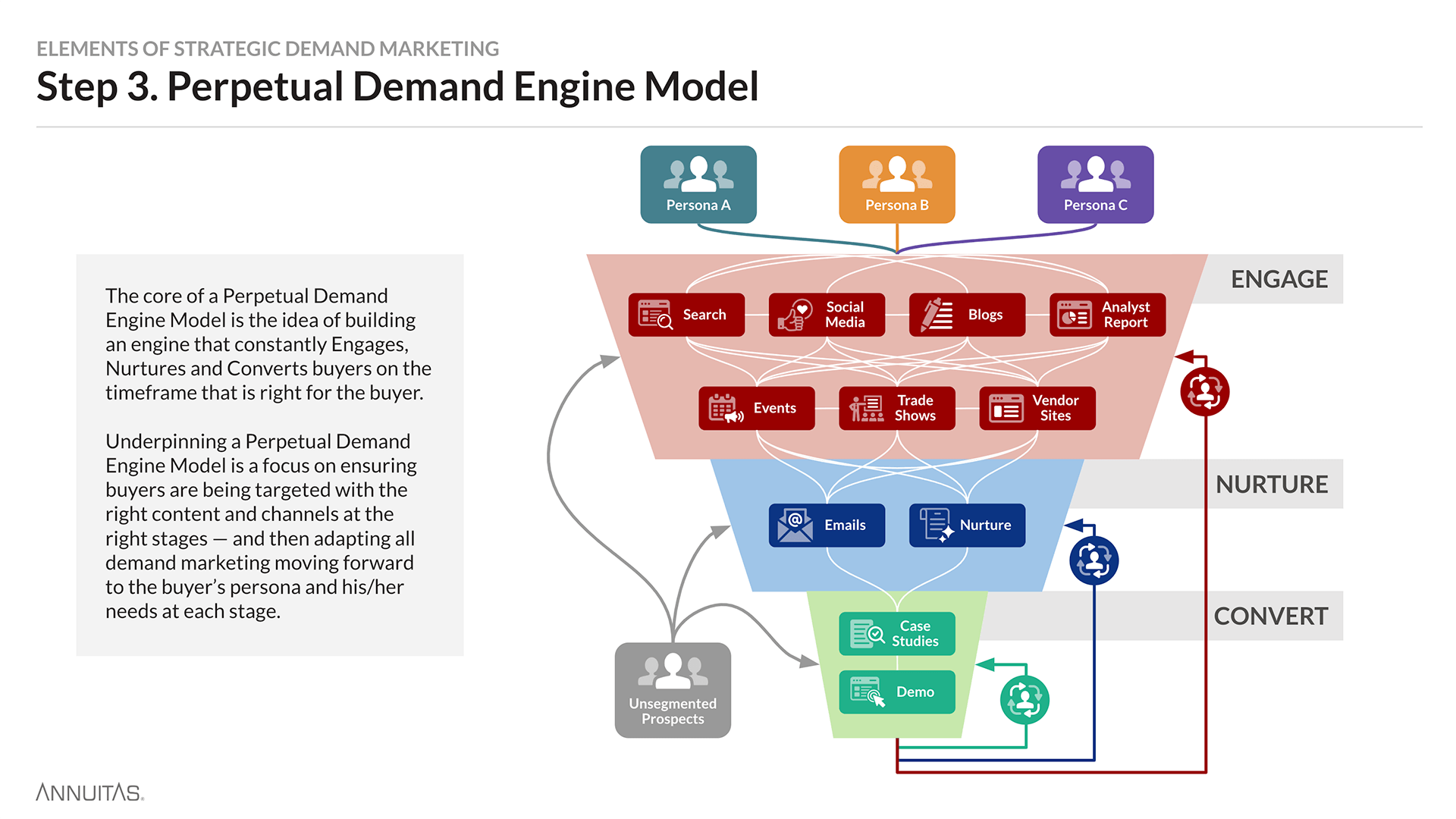
Perpetual Demand represents a unique opportunity to not only counter the challenges we face but also to ultimately re-gain control of our go‑to‑market.
We should not assume in the current buying environment that somehow ‘initiative’ has been lost as a vendor … as a marketer and a seller.
Forrester researcher Amy Hayes explains, “Buyers [derive] more meaning from vendors than they [do] from other sources.” That’s why the key opportunity in B2B go‑to‑market motions is to operate as an expert voice, supporting the buying process in a value-added fashion and orchestrating interactions to build coherence and credibility. “When it comes to content, vendor presentations [top] the list for buyer influence in complex purchases,” she notes. As a B2B “vendor” we need to use our voice not to ‘interrupt’ but rather to advise … to add value. But we need a platform to proactively enable this constant advisory position.
Our Perpetual Demand Engine must operate at the center of (and orchestrate) our go‑to‑market efforts – a strategic, always-on, multi-channel Demand Program that puts B2B marketing and sales organizations back in the driver’s seat, re-gaining engagement, predictability and the scalability of Demand Programs and of the end-to-end GTM funnel.
The Key Elements of a Perpetual Demand Approach
A Perpetual Demand Engine operationalizes and automates strategic demand motions around buyer journey.
This enables us to:
- Nurture and advise targeted prospects, multi-channel, at their buying pace
- Deliver higher quality, intent-based, account-based Qualified Leads to sellers
- Bridge engagement across multiple stakeholders – targeting entire buying groups
- Gain a 360-degree view of buyer journey – constantly (and continuously) optimizing critical path(s)
- Get full value out of your Demand Technology stack and data
A Perpetual Demand Engine doesn’t look like your historic tactical demand campaigns or growth hacks. Continuous alignment with the buyer’s critical path, requires a very different approach in our strategy and interaction.
Elements of this new approach include:
- Buyer journey “stewardship” mindset and operational approach. The core of a Perpetual Demand approach is adding value throughout the entire buyer journey by ensuring we have covered key information requests and buying stage needs at every stage of the journey. Said differently, a Perpetual Demand Engine serves as an effective and pervasive steward of our buyer’s journey. This obviously covers the content and topics we build into our content marketing and sales enablement models; however, it goes beyond content and enablement. It also means rationalizing engagement channel targeting, which changes by stakeholder and by buying stage, and whether interactions are ‘self serve’ vs. seller-intermediated, which buyers have strong preferences around.
We know that “[t]ypical buyers don’t reach out to sellers until they are 69% of the way through [their process],” according to 6sense. Thus our Perpetual Demand Engine provides stewardship for more than 2/3 of the buyer’s journey – critical phases that cannot otherwise be covered by live sales teams.
Operationalizing this approach requires frameworks such as a Conversation Track Architecture to define the conversation stages and segments. And Conversation Tracks should be embedded in an overall, integrated Demand Process to ensure people, process, content, technology and data are working together to support orchestration of engagement. Finally, a critical element of stewardship is making sure that across marketing and sales teams it is always clear ‘who’ owns stewardship of a given stakeholder at a specific stage of the buying journey. There can be no gaps.
- Portfolio view of content, engagement channels and touchpoints. There is no single point of interaction that singularly drives conversion; rather, there is a massive amount of interaction that is required – across stakeholders and buying stages. We need to build a portfolio that supports all facets of buyer journey stewardship. And we need to orchestrate these interactions. Leveraging Conversation Track Architecture, we can map out the buyer dialogue threads and align content and channels. Then we can use our marketing automation technology not to merely tee up emails but rather to orchestrate this multi-channel interaction in real time.
- Buyer-journey-informed, multi-factor view of intent. Somehow a few years back, ‘intent’ became a category of data source that a vendor is happy to sell you. But knowing a company is possibly looking for a solution – in broad terms – is just one step in discerning intent. We also need to know the stakeholders and where they are in their buying journeys. Thus, we need to build an intent profile that is composed of not only third-party intent data, but also insight into sustained engagement with key stakeholders, account-based data and content interactions that align to buying stages. Upleveling our approach to intent enables us to have a more precise view into buyer journey (by stakeholder) and to better target engagement appropriately.
- Leveraging automation and AI to improve buyer engagement, not merely to increase touchpoints. The real value-add of automation and of AI is to help us find the right mix – the critical path – of content offers and of engagement channels that leads to consistent conversion for each of our targeted segments. Thus, rather than leaning on AI to generate cold emails and/or to pump out undifferentiated content, we should leverage this technology as part of our Perpetual Demand Engine to improve real-time personalization across channels, to refine multi-factor scoring – getting a better POV on ‘intent’ over time – and to deliver critical insights for optimization of the engine
- Focusing optimization efforts on DX, not CX. How do we tune our Demand Programs? Our goal shouldn’t merely to maximize impressions or email clicks. Rather, it should be to optimize what we call Demand Experience (DX). DX is the sum of ALL of the points of interaction between a company’s marketing, sales and customer success organizations and the resultant impact on initial sale and longer-term growth of a customer’s account. It defines the critical path of a customer’s commercial lifecycle, and as we optimize this critical path, lift to DX should drive growth through lift to pipeline and lift to customer lifetime value (CLV). For Perpetual Demand, we optimize for DX … not CX.
- Fundamental shift from Tactical Demand Generation to Strategic Demand Marketing. All of these elements of a Perpetual Demand approach also speak to a wholesale shift in mindset around Demand Programs. One where we are focused on going to market outside-in vs. inside out – i.e., where being right place, right time is defined by buyer journey vs. marketing and sales campaigns. And one of continuous engagement and of optimization, vs. the periodic (and time-bound) cadence of campaigning. This is the shift from Tactical Demand Generation to Strategic Demand Marketing.
Approaching Perpetual Demand
Clearly it’s time to re-think our approach to demand marketing – to make the shift to a Perpetual Demand approach.
Where do we start?
The ANNUITAS team has built out a set of resources to help you approach and execute on this change. Below is a selection of content pieces to get you started:
DEMAND PAIN POINTS
- The Real Cost of a Short-term Go‑to‑market Mindset
- Are You Committing Random Acts of Marketing and Sales?
- Four “Random Acts” of Demand Marketing You Need to Stop If You Are Going to Achieve Perpetual Growth
RE-FRAMING OUR APPROACH TO DEMAND PROGRAMS
- Making the Critical Shift from Tactical Demand Generation to Strategic Demand Marketing
- Demand Marketing Transformation: The Path to Strategic Demand Marketing